
01 | Here And Now
The opening statement from my most recent book, Towards a New Kind of Building, is: “The world is changing. So is architecture, the art of building, primarily due to evolving communication and manufacturing methods that have changed drastically and with increasing speed.” Drafting this new book during the COVID-19 pandemic, during the continuing denial of the ever-increasing climate crisis, during continuing blatant racism, during an ever-increasing schism between people with low incomes and the super-rich, during the war that Russia has imposed on Ukraine, I need to add “and due to evolving social dynamics”. In response to the pandemic, the climate crisis, blazing war rhetoric, the alternative truths of fake news spreaders, in response to poverty and injustice, and an increasing number of warmongers, scientists, artists, and architects are imagining new rules for the new economy, eventually crystallizing into new tangible projects. New cultural rules based on new forms of social distancing, climate justice, and war-mongering are likely to become more permanent in the years to come. People will change their spatial behavior, how and where they meet, how and where they communicate, how they move from one place to another, how they shop, relax and work, and, as a direct result of their adjusted social behavior, we rebound to see substantial changes in the way materials are mined, how products are designed and fabricated, how urban environments are reimagined and built.
I started writing at the beginning of the COVID-19 pandemic, during the years of relative abstinence from travel and consumption, and in response to the public denial, especially from the side of freedom of speech propagandists, of the virus’s permanence. The virus is here to stay, and we will need to protect ourselves structurally by repeated vaccinations and by respecting the rights of those with underlying medical conditions. While writing, it became clear to me that I need to question how the new societal rules might relate to my design strategies as developed over the last 4 decades. Is there a relationship at all, and if yes, what exactly is its nature?
My initial hunch was that there is indeed a strong correlation between rule-based design strategies, such as conceptual and parametric design, and robotic production and assembly methods. This correlation exists in both the realms of art and architecture and the new societal rules, which inspired me to author this book. Most significantly, the correlations are deep in my proposals for cities and event structures, ranging from my provocative graduation project, Strook door Nederland (figure 1), from 1978, to our latest event sculpture proposal, The Seven Daughters. As the primary focus of this book is on the leading role of the component in science, culture, art, and architecture, I will look at the COVID-19 virus as an invasive actor with a far-reaching influence on everything it touches. When I started writing in January 2020, I did not intend to consider the effects of viral outbreaks concerning my design strategies, but now, almost two years later, I have no choice. The resonance between the swarm behavior of viral infections and numerous other natural phenomena, along with the communication between the interacting components of the new kind of building, is too strong to ignore.

Figure 1: Kas Oosterhuis, Strook door Nederland, 1979
At the peak of the COVID-19 crisis, concerned designers argued for a permanent reduction in travel and production volume, a decrease in global trade, and a return to more essential values of daily life, work, and leisure activities. They called for a reevaluation of the meaning of work and home. Yet, I have a different take on it, since what one is arguing for is to do less of the same, to return to a simpler yet in principle the same way of living one’s life. What kind of economy would that entail? What financial system would support such a downsizing of the economy? Can worldwide negative economic growth support an increasingly large world population? Arguments like these seem to me nostalgic and white supremacist, while the world is much bigger than the USA and Europe! Currently, the whole continent of Africa produces just 5% of the global residential and industrial carbon dioxide emissions, yet it is most vulnerable to the climate changes caused by these emissions. Should their economy also shrink? Asia and Africa are emerging superpowers, rightfully requesting a level playing field. While global warming is already out of control, when Asia and Africa produce their fair share of greenhouse gases at the same rate as the Western world, Earth will unbearably heat up. Therefore, even a drastic reduction in our current level of carbon dioxide emissions would not make a substantial difference. When a problem is too big, one gets paralyzed, and the only option seems to be dancing on the edge of the volcano.
Instead of doing less of the same or nothing at all, there is an open window to move towards a highly capital-intensive techno-social economy that levels out the downsides of mass production and neo-capitalist inequality, while securing a good life for all seven, eight, to eventually ten billion inhabitants of Spaceship Earth. The growth of the techno-social economy is in the level of capital invested, and not in the number of products it produces. To achieve a new normal, well-balanced situation, one must thoroughly reconsider the methods of agricultural and industrial production. Ubiquitous robotic production, production on command, scalable food, energy, and water production, universal basic income and ownership rights, automated transport systems, ubiquitous booking of homes and workplaces, and peer-to-peer decentralized transactions will form the basis for an economy that I call Another Normal. Networked, scalable, distributed production and consumption patterns will lead to more intimate ties between consumers and producers. The constituent components of the techno-social global culture must be produced only where, when, and as needed. We must replace centralized mass production methods with decentralized mass customization of the unique components that make up almost everything. The paradigm of customization will invade all levels of society, as it is scalable from the very small to the substantial, eventually leading to an intensified, information-rich, capital-intensive decentralized economy —an economy of the swarm. This book is about the components that make up the swarm.
Components that are, in principle, real-time acting protocells. Like monads, components are the most minor constituent parts that interact to form the bigger whole. The word component has already been prominent in many of my earlier writings, notably in Towards A New Kind Of Building [TaNKoB]. In 2019, I organized the fourth Game Set Match Conference, GSM4Q, at Qatar University in Doha, Qatar. The motto of the conference was not coincidentally “Nomads and Monads”. The notion of the component offers a focused viewing angle, a vantage point for analyzing the relations between components at varying scales across different disciplines, a framework for critically self-analyzing my design intentions, and a referential framework to scrutinize early design concepts in the context of today’s pandemic-struck society. While typically each design project has layers of meaning, the design, production, and assembly of unique interacting components represent just one of those layers, albeit an elementary one. I deliberately do not assign a central position for the component, as there is no order among the layers of meaning that would justify such a position. As in the hive, in the flock, in the swarm, there is nothing and no one central.
The system of ordering among the layers of meaning does not paint a static picture; rather, it is intrinsically a complex adaptive system. This book is 1] A selective flashback of four decades of my work in practice and academia [What have we done], 2] A critical account of where I stand right now in 2020 [Where are we now], and 3] An anticipatory look into the coming decade [Where do we go]. My last book, Towards a New Kind of Building, dates back more than one decade. The pandemic gave me the time and space to draft this book. I have typically written previous books in shorter periods. In just one summer, I wrote Hyperbodies, towards an E-motive Architecture for Antonino Saggio’s charming series IT Revolution in Architecture.
TANKOB took me half a year, but for this book, I have been working an average of two hours per day over the last two pandemic years. A typical attention span is typically not longer than two hours, for anything from writing to watching movies or participating in a Zoom session. In the years after I wrote TANKOB, two of my featured projects, the cultural center Bálna Budapest [figure 2] and the Liwa Tower in Abu Dhabi, were completed, representing the uncompromising applications of what I discussed in the TANKOB book, executed in our compact and efficient design practice, ONL [Oosterhuis_Lénárd]. We managed to design and implement larger projects with a small staff. When discussing the production of drawings for the Bálna Budapest, one architect advisor to the client insisted that I should have at least thirty to forty people working on the project.

Figure 2: ONL, Bálna Budapest, 2012
In contrast, I had a permanent staff of three young architects in the ONL Hungary office in Budapest. The outside world had the impression that we ran a much bigger office than we actually had. In reality, the largest team was about twelve people in our Rotterdam office: six staff members and six trainees. We had a similar team size at Hyperbody TU Delft. Starting as a professor from practice with one assistant, we managed to grow into a team of twelve people, assistant professors, Ph.D. candidates, and teaching assistants, at its peak, after the financial crisis of 2008, step by step, to be reduced to only six people by 2016, the year of my retirement due to TU Delft’s age policies.
The What Have I Done chapter highlights my decade as a freelancer, three decades of ONL in Rotterdam, and nearly two decades at Hyperbody at TU Delft, where I held a professorship at the Digital Architecture chair from 2000 to 2016. Later on in this book, where I discuss the components of Interactive Architecture, I have included links to the editorials I wrote for the iA series of Interactive Architecture, a series of 5 issues, in a cute, small format, especially for use by students.

Figure 3: ONL, Body Chair, 2014
The swarm behavior of interacting components and component-based design form the solid basis for the ONL and Hyperbody projects. Having developed radical customization systems through in-house programming and file-to-factory production methods over the past four decades, it seems fair to say that, in hindsight, my work anticipated the societal changes promised by the current COVID-19 pandemic. Making things work has been my leading design principle from the start. Making things work means designing a system that accomplishes its intended purpose, like the scripts for the Saltwater Pavilion, the Web of North-Holland, the A2 Cockpit in the Acoustic Barrier, and the interactive installations of ONL and Hyperbody. Scripts for data-driven production by CNC [computer numerical control] machines and components for interactive installations either function correctly or do not work at all. One wrong number or text in the script, one line of code missing, and it doesn’t work at all; in scripts, even the most minor details have to be right. That is what makes the scripts verifiable; that’s why scripts potentially form the basis for an open, transparent society. The digital is superior to the analog; in the digital, there are no metaphorical stories, there are no lies or excuses, and it simply has to work.
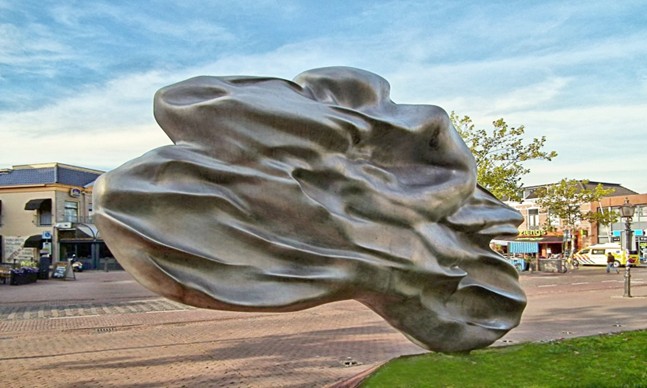
Figure 4: Ilona Lénárd, TT Monument, 2002
My keen interest as a designer focuses on making things work by clearly defining the digital components that assemble the constructs. Component-based design works as a principle at any scale, from furniture design, the Body Chair [figure 3], art projects in public space, Ilona Lénárd’s TT Monument [figure 4], pavilions, the iWEB, buildings, the A2 Cockpit, master planning, Manhal Oasis, to interactive installations, Festo Interactive Wall. I will demonstrate that procedural customization and component-based thinking work well for concrete art, aka not abstracted from reality, as in the autonomous paintings of Ilona Lénárd, which I described in the Ubiquitous Symmetry paper. As a matter of principle, ONL and Hyperbody base their projects on hands-on, in-house developed and tested design techniques. None of the designs and installations are assumptions or hypothetical constructs that exist only in theory. “You can do anything as long as it works,” I typically tell my TU Delft students, which is the modus operandi of the autonomous artist. Artists cannot hide behind anyone else; they are solely responsible for the result, which is the ultimate vulnerable position to take. There is no one else to blame when things go wrong or aren’t successful. There is no one to rescue the artist from a self-chosen road to nowhere, from lines of thought that are not picked up by others, for which the artists might have hoped. When it does not work, so be it, try harder or leave it, and concentrate on the next challenge. And nothing else pleases the artist more than when others appreciate their unsolicited work, and, eventually, clients show up.
At ONL, we always solved the equations for the parametric design to robotic production ourselves. I did not want to throw problems over the fence, relying on the likes of Arup and Happold to solve the geometry and the preparation for production. Yet, that is still a widespread practice in architectural design offices. In the linear building process, everything must link directly to a previous and a future step in the development: from design concepts to engineers, from building permit plans to the tender procedure, from the tender to contractors, and finally to manufacturers, who actually make the components, and vice versa through the whole building chain to optimize the process. At ONL, we worked with the highest precision in parametric modeling. We wrote the scripts to produce results directly from our data and took responsibility for the correctness of the data. We managed to unchain the traditional building chain by teaming up with manufacturers directly, creating a non-linear network instead of a linear chain, for both small works of art in public spaces and for larger buildings. In that sense, I have always been more of an artist than an architect. Not surprisingly, from the start of ONL [Oosterhuis_Lénárd] as a joint office between an architect and an artist, our motto has been “The fusion of art and architecture on a digital platform.” Just like any artist, we primarily work to educate ourselves, and only secondarily to please a client. We do not “serve” the client, as says the professional code of conduct for architects. Artists are entrepreneurs who work differently from commercial architects and project developers, who primarily aim for profit and use architecture as a vehicle to accumulate their wealth. We pursue the design challenge of uncharted territories initially and use the remuneration to support our efforts. We could only afford this attitude since we have been a small enterprise through the years. I realize in hindsight that my design philosophy and our working methods, implemented in such compact design teams as at ONL and Hyperbody, have seriously limited the number of clients we were able to attract.
The What Have We Done chapter includes my view on Patrik Schumacher’s Parametricism. Since Zaha Hadid’s untimely death in 2016, Patrick Schumacher has effectively taken over the ZHA office and has emerged as their theoretical leader. He successfully merges Hadid’s flamboyance with parametric design and libertarian political ideas. However, neither of the three components has much to do with the other. Hadid’s personal style has no congruence with parametric design, while parametric design has not much, if anything at all, to do with neo-libertarian thinking. The combination feels a bit treacherous to Hadid’s original style, to parametric design, and to techno-feudal capitalism alike. Hadid is famous for her calligraphic sweeps, first angular and later in smoother strokes, but in no way parametric. I have written more about Zaha Hadid’s calligraphic sweeps in my blog on my personal website. It seems to me that in the libertarian mantra of unfettered free competition, the “me, myself and I,” productivity growth, and the money, but not the content, is the main subject of interest.
On the other hand, parametric design is instrumental in a participatory form of architecture, which is, in its essence, inclusive and collaborative, not competitive. Technically, parametric design in itself is toneless, if not linked to robotic production methods. In the following pages, I argue for an architectural practice that hinges on equally emotive as systemic methods of thinking, designing, and producing, making things work for a fair share of the global population.
In general, I prefer the term Associative Modeling over parametric modeling, as elaborated upon in my white paper, Associative Information Modeling [2015]. Associative Modeling is a very accurate term, coined by the British architectural computer programmer Robert Aish, who developed the software Generative Components for Bentley Systems. ONL was 2014 2015 briefly operating under the name VAA.ONL, a fusion between Van Aken Architecten in Eindhoven [now taken over by the multinational Sweco] and ONL. Unfortunately, the merger with Van Aken Architecten did not work out well. In 2015, Van Aken went bankrupt and almost dragged ONL along into the abyss. Fortunately, the new owner, who had been one of the previous directors, saved our fate, and we got our portfolio back into our own hands.
In the ” Another Normal chapter, I write about the synthesis of components into a coherent building body. My view on the synthetic contrasts with the bio-digital mimesis approach, which claims to design after and with nature, to mothering nature, as Neri Oxman puts it. Oxman wishes to work with natural agents as active co-builders, thereby maneuvering herself in a fringe position; her empathic, delicate bio-inspired approach is not fit to be scaled up to the robust scale of the global building industry. I am critical of growing building materials using mushrooms or growing structures using living silkworms [MIT Silk Pavilion], despite their intrinsic beauty. Neither do I wish to jump into disproportional illusions to clean polluted air [Daan Roosegaarde’s Smog Free Tower], explained in my essay The Smog Free Illusion, nor do I embrace literal forms of biomimicry. I am more interested in the inner drive of a system than in observable similarities. We might try to imitate superficial features of natural systems, like the wings of birds, but that does not respect the intrinsic logic of natural systems, nor the logic of synthetic systems. The fixed wings of airplanes have a design that is distinct from the flapping wings of birds. Biomimetic designs are typically too literal, depending on or working with existing nature. My architectural vision aims at constructing a hitherto unseen, unknown, alien form of synthesized, digitally informed nature. The total mass of technical extensions to our bodies, constituting our exo-brains, exo-hands, and exo-eyes, has reached the point that it exceeds the total biomass on Earth. A blanket of cities, infrastructure, vehicles, furniture, household objects, computers, and cellphones covers the surface of Earth; satellites populate the skies, and artifacts make up everything that we see and appreciate around us. We live inside our bodily extensions, inside this physical augmented reality. All of these extensions belong to the synthetic world of design, engineering, production, and building. Design to build is synthetic by nature; there is no need to imitate biological systems. Because of the difference in scale, the speed of evolution, and the choice of materials, synthesized structures have a logic of their own. Synthetic architecture applies a simpler logic of synthesizing the building body from its constituting components than how DNA and cell structures construct living nature. When I look at the workings of a single biological cell and its immediate environment, I may compare its complexity with a complete city and its connections to neighboring cities. A cell is like a city, complete with its factories, energy centers, storage, universities, libraries, and homes, while the inhabitants primarily act as messengers and information carriers. As in the city, vehicles, data carriers, tolls, borders, filters, and semi-permeable membranes follow the internal logic and rules of the city game. In the synthetic world, the essential building components are the monadic cells that evolve in a complex adaptive process, following a logic of their own, in close contact with their immediate neighbors. They are what they are, and they do what they do; the components are the agents of the swarm. We have by far not arrived at the same level of complexity in our human-assisted synthetic world as in the pre-industrial natural world, yet we are developing fast. Since we have started embedding real-time interaction, neural networks, and artificial intelligence into the building components of our worldmaking, we have already come a long way towards a natural complexity that we might label as Nature 2.0, the sequel. I do not want to speculate on future developments, nor do I want to fall into the trap of a Trumpist superlative turbo-language, i.e., not use words like amazing, incredible, or never seen before. My down-to-earth approach follows the adage “What you see is what you see”, coined by the American artist Frank Stella when being asked for an explanation of his work, to avoid making up stories that are bigger than the work itself. Similarly, ONL’s and Hyperbody’s building components are what they are, and they do what they do.
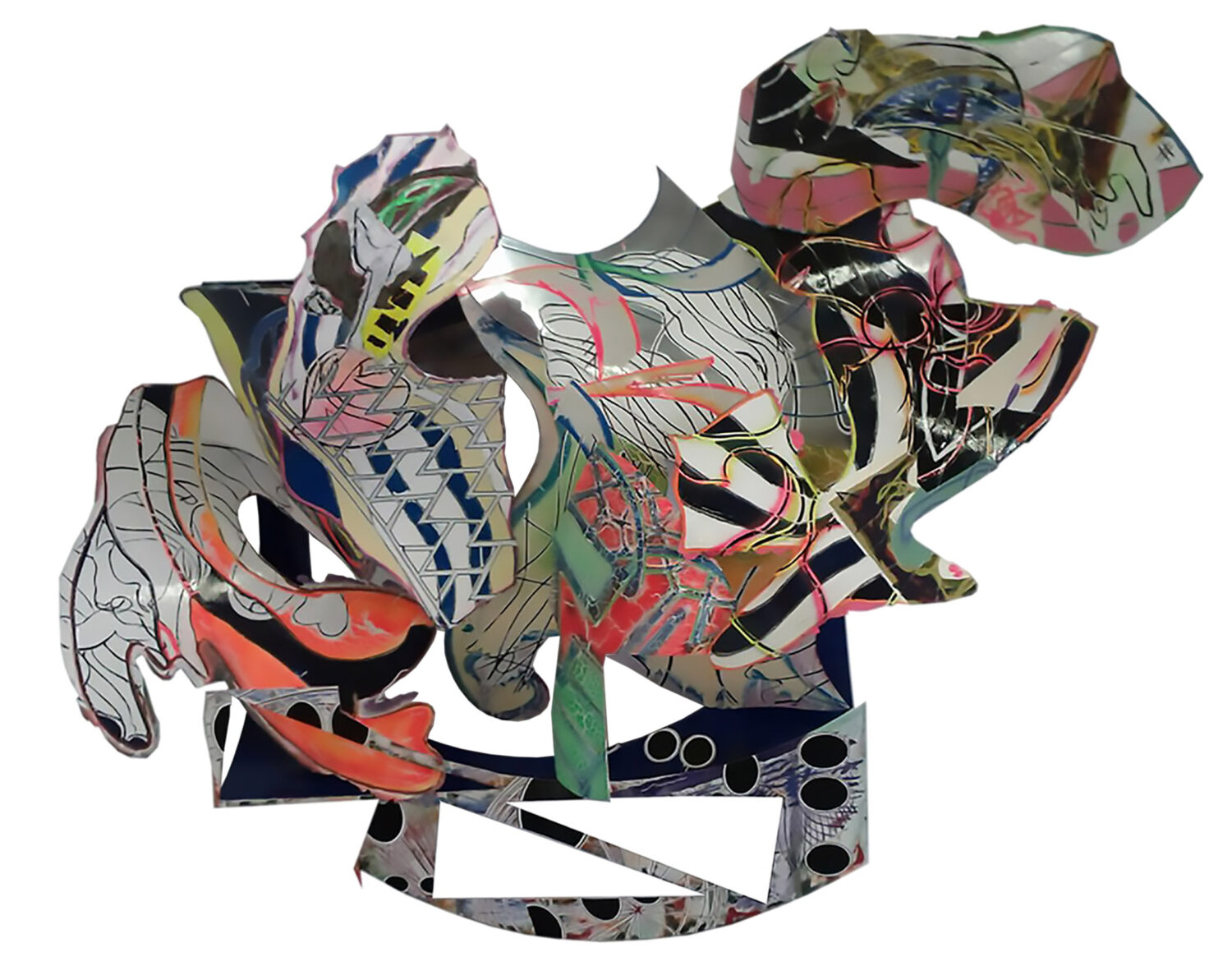
Figure 5: Frank Stella, Cetology, 1991
Also in Another Normal chapter, I discuss how science inspires me in the first place, especially the science of natural physics, exploring the quantum nature of the universe and of subatomic vibrations. I like to think that there is a relationship between the elementary processes in the universe and data-driven component-based design, not only on a theoretical level but also hands-on, establishing the connections between the components. Interactions and connections between components are even more relevant to understanding a system than the physical components themselves. Art and science inform synthetic architecture, synthesizing from the bottom up to the larger whole, by the design of the associated components, and their mutual relationships, as actors in the swarm. Of primary interest are the rules of law, the rules of the design game, and, in terms of its visual appearance, the shape of the law as I demonstrated in the Strook door Nederland. Learning from science and art, I have adopted a working method that celebrates the swarm. Multiple components that are similar but not the same are flocking together in the design constellations, looking at each other and building relationships with each other. As early as the early nineties, I realized that associative design is the natural instrument to deal with rules and variables. The parametric design systemic way of thinking is open not only to self-chosen variables, but even more relevant, as we will see towards the end of this book, for the principles of inclusive design, whereby each player plays the rules of the interactive design game on a level playing field, experts and laypeople alike. Measuring, verifying, and evaluating data is key to the development of any of the designs, and, in a broader context, applicable to the new rules of the economy of Another Normal, discussed in the concluding chapter, The Chinese Patient. Social distancing and ubiquitous booking are based on the engineering principles of “measuring is knowing.” What can be more pleasing than to live in a world without waiting in lines at the airports, in shops, and in heavy traffic? What can be more attractive than paying on the fly instead of waiting in line at the cashier’s desk? Processing of data in real-time is key to making the new economy work. The underlying technologies of real-time data processing build the foundations for the new nomadic citizen. At Qatar University, I developed the concept of the Ubiquitous Booking App for the MANIC research project. This application allows you to book anything, anywhere, for any time, merging lease and ownership in one overarching global system. Universal basic income, ubiquitous land ownership, ubiquitous food, energy, and water production, ubiquitous AI-driven transportation, ubiquitous robotic production, and ubiquitous home delivery are the supporting pillars of the concept of ubiquitously available Multimodal Accommodations for the Nomadic International Citizen.
In the Ubiquitous Components chapter, I dive deeper into the role of the component in other fields of knowledge, in science, language, music, and art. Not being an expert in those fields, I take the risk of being under-informed and jump to conclusions that are not well-founded. Yet, it is instrumental to at least try to figure out to what extent my approach to the component in architecture resonates with the role of the component in other fields of expertise. What is common in my explorations into other fields is that, in my view, all manufactured artifacts are a natural extension of nature, not opposed to what we romantically perceive as nature. Components are the physical form of an executable; components act, do things, perform, they make things work. An executable file in the world of computation is a component that runs the program inside a computer. At the same time, the computer is a higher-level component designed to communicate with other computers. As in the nanoworld, as in the universe, in our organic, tangible world, all components across scales are actors, executing a program. Every identifiable component, whether big or small, I consider to be an information-processing vehicle. A house is an information processing unit, as is a factory. The input, the process, and the output vary, but all artifacts are information-processing vehicles like we ourselves are. As we live in a dynamic world, every single component is an actor that establishes bidirectional relations with others. The key message of this book is that components can no longer be dealt with as static elements, as dead bodies. Components are actors that are very much alive, whether living very slowly in the form of visually immobile objects or at high speed like packages of information traveling at the speed of light. Components, whether slow or fast, must in principle be kept alive and kicking to be actors interacting with neighboring actors. To design means to design the interactions between the actors.
The Components versus Elements chapter is a mirror image of Rem Koolhaas’ Venice Architecture Biennale of 2014. I grill his fifteen “fundamentals”, one by one; where he registers elements, I am looking for components. While his elements are typically mass-produced products without a predefined context, my components are unique, customized parts that fit only in a particular place, in a bi-directional relationship with their immediate neighboring components. My components are live actors, establishing connections to their immediate neighbors, like the parts of a three-dimensional puzzle. Koolhaas’ elements typically clash with each other in a deconstructivist style, where they do not know or care about one another. At the same time, my components are well aware of each other and acknowledge the need to inform one another about their dimensions, shapes, and performance to connect. For me, architecture is a synthesis of Precog-style [The Minority Report, Philip K. Dick, 1956] components, components that know where they are going to fit in.
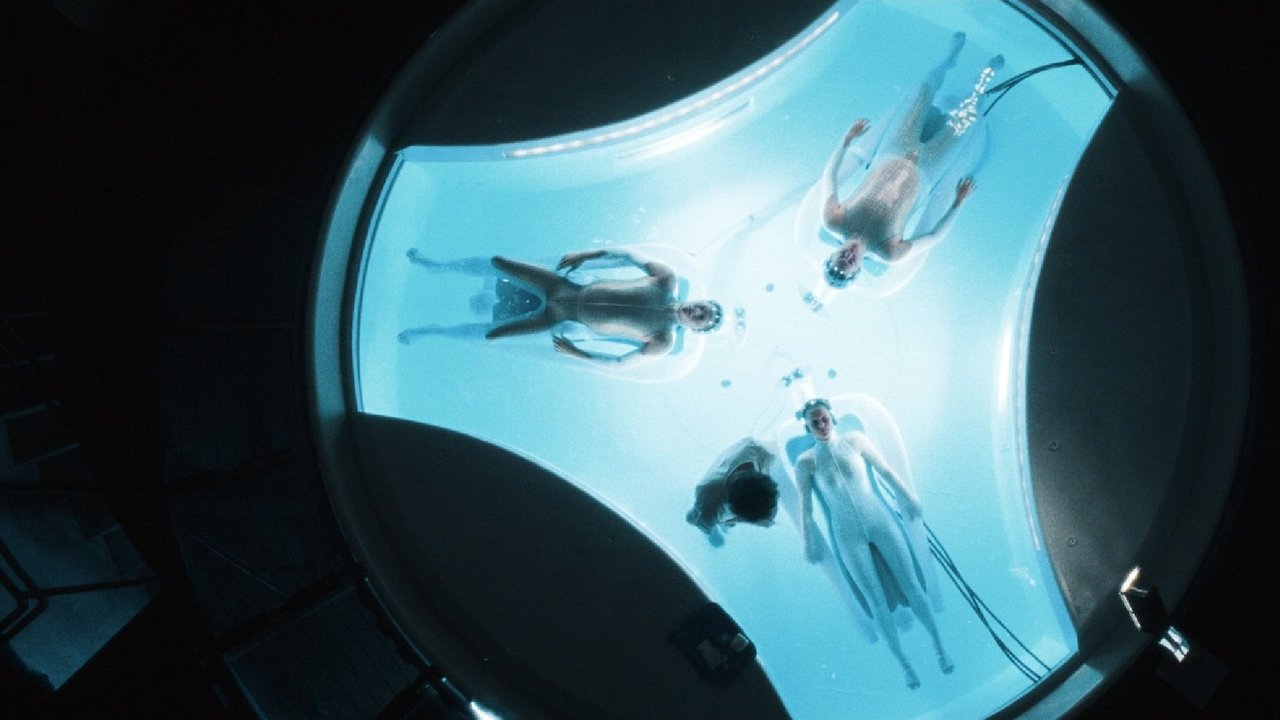
Figure 6: Precogs. Minority Report, 2002
The Component chapter hosts a detailed description of a series of ONL projects seen from the perspective of their constituent, passively acting components. It expands on the development from mass production to mass-customized design-to-production methods. Every new project represents another step toward the “one building one detail” paradigm that characterizes the most recent ONL projects. The series of subsequent projects demonstrates the inevitable self-initiation of radical customization. This inevitability is a self-imposed regime that rules my thinking whenever I design furniture, or buildings, or participate in joint art projects. One building, one detail is what I do, this is what I am, and this will be my legacy.
Nonstandard architecture is an inclusive approach since it allows for the exact description of both traditional rectangular and smooth fluid architecture. Interactive architecture adds another level of inclusiveness by allowing for the programming of both static and dynamic structures. Component-based design is the ultimate form of open-ended inclusiveness, describing the structures at their most generic level. Component-based design is not the ultimate form of specialization; in fact, it is the most generic form of architecture. Components are the acting parts of the real world, not an abstraction from reality as elements are.
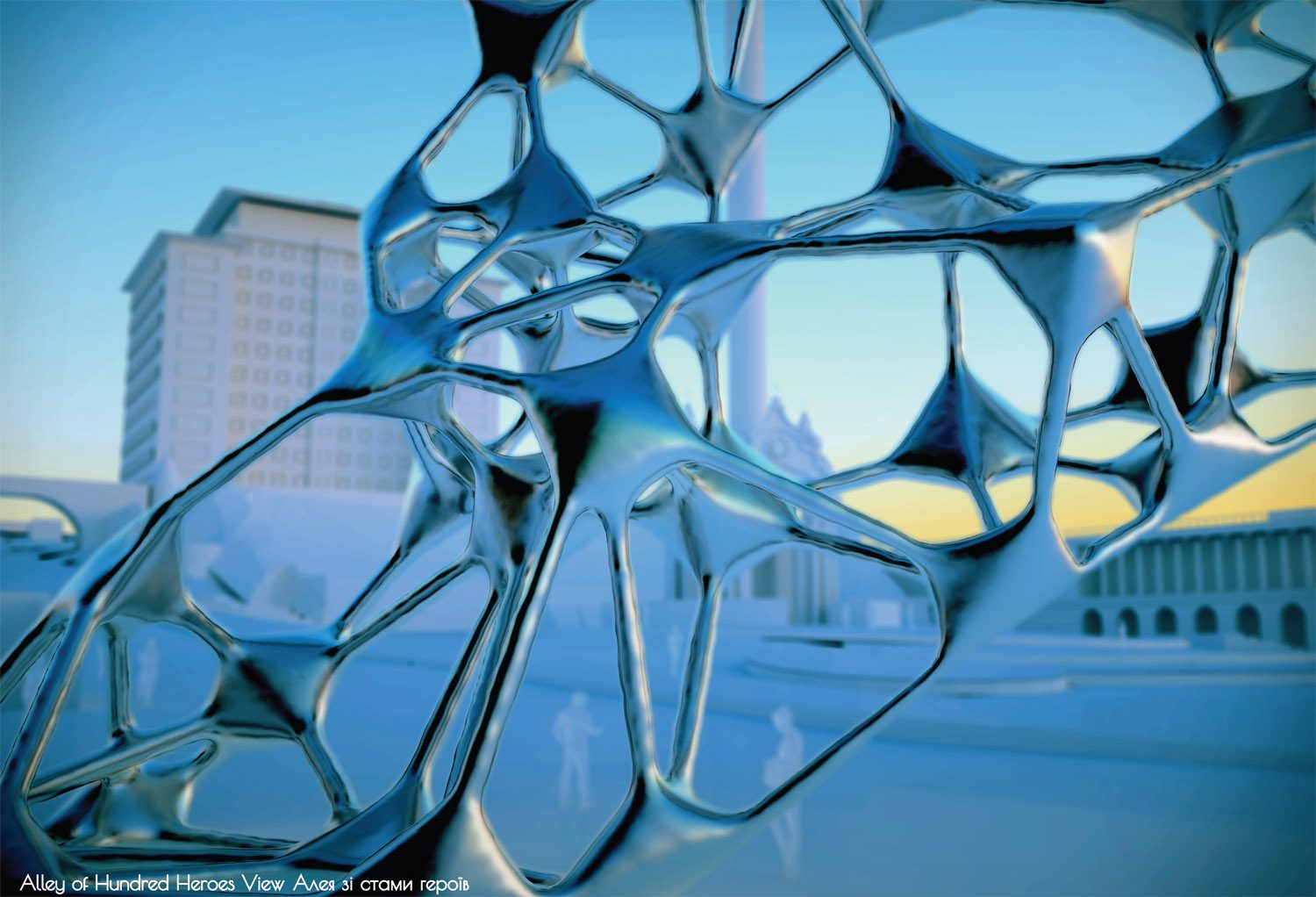
Figure 7: Maidan Monument for Hundred Heavenly Heroes, 2018
In the Where Are We Now chapter, I discuss projects that I designed and initiated in the years 2017 to 2019, in my role as educator and researcher at the Department of Architecture and Urban Planning at Qatar University, as a partner in art projects with visual artist Ilona Lénárd, and in my continuous capacity as ONL’s lead architect. I chose “Where Are We Now” as the title of my lecture at the international GSM4Q conference at QU, which I organized in February 2019. GSM4Q is the sequel to the GSM I [2002], GSM II [2006], and GSM III [2016] conferences, which I initiated at TU Delft. The GSM4Q lecture is an account of the works developed and executed in Qatar, design studios and workshops with my students at Qatar University, competition projects created with a team of Qatar-based architects, art projects by and with Ilona Lénárd, research projects like MANIC funded by Qatar University, and ONL projects done in collaboration with a Dutch team of young architects. The Maidan Monument for Hundred Heavenly Heroes in Kyiv is on www.oosterhuis.nl. The Where Are We Now chapter addresses the actual situation we find ourselves in. In this chapter, I summarize my GSM4Q lecture at Qatar University.
I played the somewhat ominous David Bowie video of his surprise swan song, Where Are We Now, as the introduction to my lecture —a farewell gesture to Qatar University —while the Dean did not renew my contract for as yet unknown reasons. The Where Are We Now chapter contains a series of case studies that demonstrate how we have combined art, design, and architecture strategies developed over the years into coherent real-world proposals. In the self-analysis of the projects, the notion of the component frames the train of thought. One of our ongoing projects is the further development of the urban design instrument Participator. At its core, it is an application that allows the exploration of urban design ideas by a multidisciplinary team, laypeople, and experts alike. The design of open participatory design systems is a logical next step after parametric design for unique individual buildings. Open design systems allow for quantifiable and qualifiable variations of a structured idea, following the same logic of the file-to-factory process. Participatory design systems already exist on the Internet for customizable products like rings, glasses, furniture, and wiki-houses, typically offering a limited scope of interaction and influence on the outcome of the participatory design process. Variations are more of the same, featuring only minor differences. Participator offers a design instrument for profoundly different outcomes; besides the regular numeric sliders and randomizers, we have embedded a tool to sketch 3D trajectories that attract functional units.
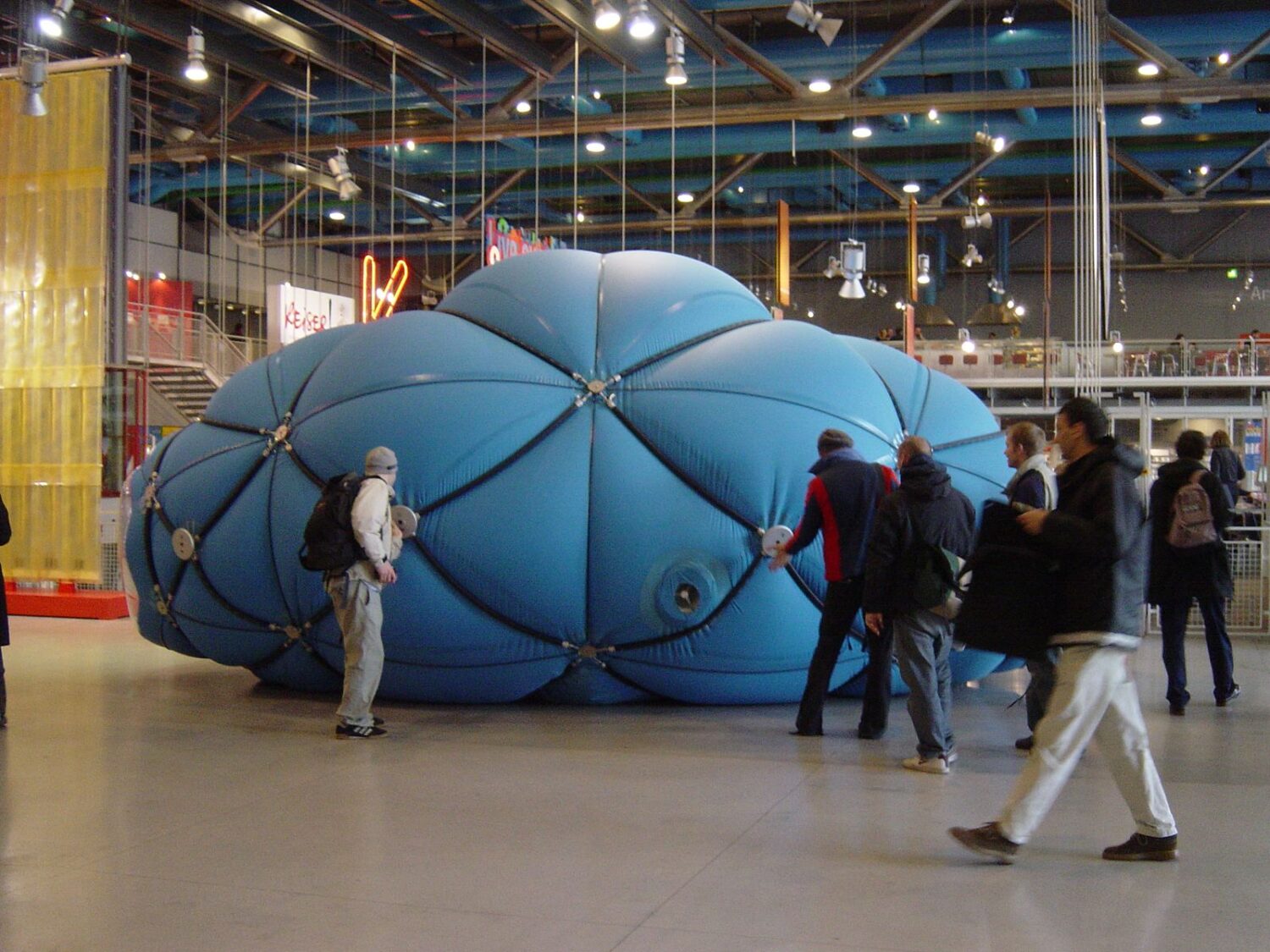
Figure 8: NSA Muscle, 2003
In the Proactive Components chapter, besides interactive ONL projects, key Hyperbody projects [Muscle Tower, NSA Muscle, Festo Interactive Wall, Pop-Up Apartment] were published on the Hyperbody Wiki pages and the Hyperbody YouTube channel. The Hyperbody website has not had any further updates since I formally closed Hyperbody in 2016. Since my retirement as a professor from practice at the TUD, the information-rich website is functioning as the Hyperbody Archive site. There is valuable information, notably on student projects under Education in the top menu bar. At Hyperbody, we stimulated the students to work with graphic programming interfaces like Nemo/Virtools, Max MSP, and Grasshopper. The notion of the component is a key unit in Grasshopper, the graphic interface to Rhinoceros 3D. David Rutten of TU Delft developed Grasshopper, released in 2007, five years after we at Hyperbody started working with the graphic interface Nemo—later renamed Virtools—for the design of interactive environments. David Rutten was aware of Hyperbody’s interactive virtual reality designs executed with Nemo / Virtools when Robert McNeel hired him to write a graphic interface for Rhino. In Grasshopper, as in ONL and Hyperbody projects, the components are actors acting upon the geometry, not unlike the sliders in the Attractor Game that I developed with my ONL team in the late nineties using Visual Basic software. For the interactive Hyperbody installations, we used Max MSP to capture and manipulate real-time streaming data that informs the interaction.
The Where Do We Go chapter describes the future outlook, extrapolating the state of the art of today, unveiling design strategies for the immediate future of buildings and urban environments, towards a more information-dense, capital-intensive, socially inclusive, abstract art-driven world. Where do we go? What practical strategies can lead us into Another Normal? How will we work and live? Are we becoming international nomadic citizens? Will we live on Mars? In this chapter, I question the role of interacting components in a variety of social, technical, biological, global, virtual, artistic, and architectural systems, as well as in design software. I remain focused on how component-based systems receive or retrieve information, how they process information, and how they send information. More than anything else, I look into the forces that are driving the components. The concept of the interacting component turns out to be scalable and ubiquitously applicable.
In the concluding chapter, The Chinese Patient, I sketch out scenarios for a reimagined post-capitalist pandemic-proof society. I describe new rules for the new economy that might come into effect sooner rather than later, provided the unprecedented global response to the 2020 pandemic also triggers the will to fight the climate crisis. As we speak, it looks like the CEOs of the international companies are not ready for the transition; they want to get as much profit out of the fossil fuel economy as possible and use the war that Russia has invoked in Ukraine as an excuse. For the time being, the CEOs and the privileged upper class prefer to dance on the edge of the volcano; they don’t take substantial action, despite continuous warnings from the United Nations and actions from the younger generations. Only a techno-socialist revolution can turn the tide, not a techno-libertarian revolution. Parametric design to robotic production is one of a dozen strategies that must converge to make the world a better place. In this last chapter, I have listed a dozen radical rule-based strategies one needs to consider to turn the tide. Earth itself will survive easily, but improving the outlook for humans needs immediate action.
First, I discuss the necessity for a Universal Basic Income [UBI] policy. Wealth-sharing policies are mandatory to reduce the ever-increasing inequality between the rich and the poor. I fail to see how [neo]libertarian policies could lead to a reduction of the inconvenient gap between the super-rich and the starving low-income people. In the USA, during the peak of the pandemic, 15% percent of the American population depended on food banks, living on charity instead of having a right to food. I do not see the logic of the CEOs of big companies to filter billions of dollars out of our pockets first, and then arbitrarily redistribute a small part of their wealth to charity. When every citizen had a basic income, there would be at least a beginning of a level playing field. Additional measures are necessary to construct a fairer and more just world. Second, people will need simple, straightforward land property rights, coined as Ubiquitous Land Rights [ULR]. In Middle Eastern countries, the state grants birthright to native citizens to own a piece of land of approximately one thousand m2. On that land, they can build their own house, grow their food, and have their own business. Subsequently, it is crucial and inevitable to introduce simple rules for Ubiquitous Food Production, Energy Production, and Water Production [UFP, UEP, UWP]. These three strategies interweave with each other into the FEW Nexus.
In the FEW nexus, proper treatment of waste becomes an essential source of renewable energy. In the footsteps of the Chinese Patient, who was locked in a Chinese psychiatric hospital for requesting better food, clothes of wool, transportation by limousine, and to transform China into one big villa park, I discuss the need for Ubiquitous Autonomous Transportation [UAT]. As we speak, leading companies evaluate automated vehicles. Hundreds of thousands of electric cars that are on the roads today are already fit to operate completely driverless, on the road, and off-road. Cityscapes will change drastically when all vehicles are AI-driven, the lanes reserved for cars can become fewer and narrower, leaving ample space for trees giving shade, enlarged pavements for [electric] bikes, and a vibrant public life. The Ubiquitous Robotic Production [URP] rule is crucial, creating a framework for the democratization of design and production. URP makes the production of almost anything affordable for everyone, including but not limited to food, energy, water, and household products. Production On Command [POC] means producing only when, where, and as needed. We should refrain from producing for the “market”; instead, we should deliver for the demand. New products are simulated, prototyped, and tested before they are produced on a larger scale. Only when there is a demand, regardless of how small, is the product produced. Crowdfunding shows a feasible way forward.
Last but not least, simple rules are needed for fine-mazed decentralized Ubiquitous Home Delivery [UHD] systems to optimize the way we do shopping. It is more efficient in terms of the number of kilometers driven and the amount of carbon dioxide produced to have almost everything delivered to your home address than to go shopping in your individual vehicle. Home delivery, by small self-driving robotic vehicles [drones, Gita, vans] is today’s digital reincarnation of the traditional milkman, baker, greengrocer, butcher, fishmonger, scissor sharpener, who used to deliver to your [grand]parent’s door until the sixties of the last century. Small-scale home delivery blends effortlessly with the principles of the walkable city. Fun shopping for social reasons, in historic city centers, would remain a leisure activity. Add to the above strategies a universal workplace strategy supported by the Ubiquitous Booking App [UBA], and we go full-cycle. The new nomadic international citizen feels at home everywhere; wherever they are, they customize their environments to make them their own. They work from anywhere in the world for a company that operates more like a distributed network rather than being bound to a fixed place. The Ubiquitous Booking App gives the new citizens an instrument to organize their private and professional lives and their social interactions.
The above rules of play are based on a digitally well-equipped society, where everyone and everything is an actor in the dynamic adaptive system, where everyone and everything interacts with their immediate neighbors, like the acting members of an interacting swarm. Being digitally well-informed and digitally well-connected is a key factor in building a prosperous society. Not only will the people need to be well-informed, but the building components that interact with their environments must also be equally well-informed. We will live our future lives as actors on the Internet of Things and People, seamlessly merging the physical and the virtual. Being well-informed is a prerequisite for things and people to play, to live inside the evolution of the game of life, and to shape Another Normal.

Figure 9: The Seven Daughters, 2019